2026 AI: Workflow Mastery Guide
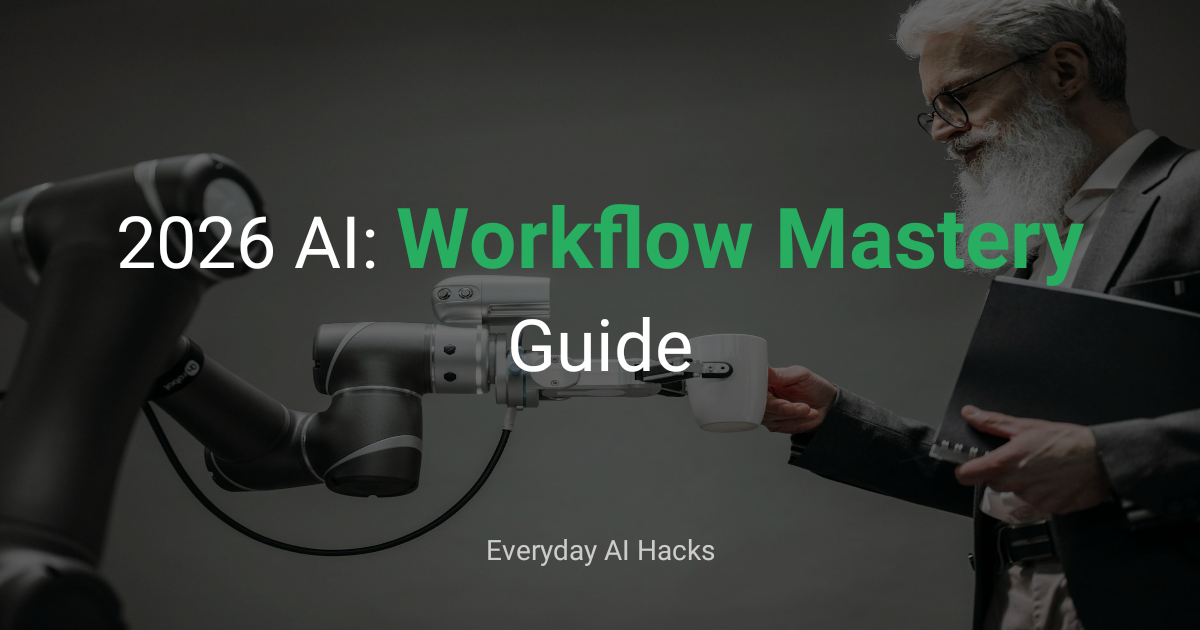
Welcome, fellow innovators and productivity seekers! I'm here in 2026, looking back at how far we've come with artificial intelligence, and honestly, the landscape is unrecognizable from just a few years ago. We've moved beyond simple chatbots and individual AI tools; today, AI isn't just assisting us – it's actively orchestrating, predicting, and elevating entire workflows to levels of efficiency we once only dreamed of.
If you're still treating AI as a novelty or a mere helper, you're missing the true revolution unfolding before our eyes. The question isn't whether AI will transform your work, but whether you'll be among the few who master its intricate dance to gain an undeniable competitive edge. This isn't just about saving a few minutes; it's about fundamentally reshaping how we create, innovate, and achieve.
Are you ready to stop just using AI and start truly *mastering* it? This guide is your definitive roadmap to navigating the sophisticated AI-powered workflows of 2026, ensuring you're not just keeping up, but leading the charge. Get ready to unlock unprecedented levels of productivity, creativity, and strategic advantage.
The AI-Powered Workflow Paradigm Shift of 2026
The year 2026 marks a pivotal moment where AI transcends individual task automation to become the very architecture of our operational efficiency. We're no longer just feeding prompts to an LLM; we're designing interconnected AI agents that communicate, learn, and execute complex, multi-stage processes autonomously. This hyper-integration means AI is now embedded at every touchpoint, from initial ideation to final delivery.
Predictive capabilities have become incredibly sophisticated, allowing AI systems to anticipate needs, identify potential bottlenecks, and even suggest proactive solutions before issues arise. This transforms reactive workflows into highly adaptive, foresight-driven ecosystems. The shift isn't merely about *using* AI; it's about fostering a synergistic collaboration, where human ingenuity guides while AI amplifies and accelerates execution.
Generative AI, in particular, has matured into a formidable co-creator across content generation, code development, and even complex industrial design. These systems are no longer just producing generic outputs; they're crafting contextually aware, highly personalized, and strategically aligned assets at scale. This paradigm shift demands a new mindset: one of orchestration, not just operation.
Architecting Your AI Ecosystem: Tools & Strategies
Building a robust AI workflow in 2026 requires a strategic approach, starting with selecting the right tools and understanding how they integrate. We now have access to a dizzying array of advanced Large Language Models (LLMs) that specialize in specific domains, alongside dedicated AI agents for tasks like data analysis, creative design, or even strategic planning. No-code AI platforms have also democratized complex AI model deployment, making custom solutions more accessible.
The core strategy for integration revolves around identifying your most significant workflow bottlenecks and pain points. Once identified, you can then choose AI tools that directly address these challenges, whether it's automating repetitive data entry, generating first drafts of complex documents, or providing real-time analytics. API connections are critical for seamless data flow, though many integrated AI suites now offer out-of-the-box compatibility.
Data hygiene remains paramount; your AI is only as good as the data it's trained on. Ensure your data sources are clean, well-structured, and consistently updated to prevent skewed insights or biased outputs. Furthermore, deploying AI securely is non-negotiable, with robust access controls and encryption becoming standard. Many organizations are now even training their own proprietary AI models on private datasets to gain a distinct competitive advantage and ensure maximum relevance.
Customization is the key to unlocking true workflow mastery. Don't settle for generic AI solutions. Invest time in fine-tuning models, creating bespoke prompts, and even developing custom AI agents that understand the unique nuances of your business and industry. This tailored approach allows your AI ecosystem to truly mirror and enhance your specific operational needs.
Real-World Workflow Transformations: Case Studies from the Future
In 2026, AI has moved beyond proof-of-concept; it's driving tangible, measurable transformations across every sector. Let's look at how industries are achieving workflow mastery.
Marketing & Sales
Marketing teams leverage AI for hyper-personalized campaign generation, from crafting unique ad copy variations for individual segments to dynamically adjusting pricing in real-time based on market demand and customer behavior. Predictive lead scoring, powered by advanced machine learning, identifies the hottest prospects with uncanny accuracy, allowing sales teams to focus their efforts where they matter most. Automated content calendars, driven by trend analysis AI, ensure perpetual relevance.
Product Development
AI plays a critical role from ideation to deployment. Generative design AI explores millions of potential product configurations, optimizing for factors like cost, durability, and aesthetics simultaneously. AI-powered code assistants write and debug complex software faster than ever, while automated testing suites catch bugs before they even become an issue. Even user feedback analysis is now automated, providing instant, actionable insights for iterative improvements.
Customer Service
Proactive AI assistants anticipate customer needs, often resolving issues before the customer even realizes they have one. Advanced LLMs power self-service portals that provide nuanced, accurate answers to complex queries, drastically reducing call volumes. Sentiment analysis AI routes critical customer interactions to human agents based on emotional tone, ensuring high-priority cases receive immediate, empathetic attention. This creates a seamless, low-friction customer journey.
Operations & Logistics
AI optimizes supply chains by predicting demand fluctuations, rerouting shipments to avoid delays, and identifying potential component shortages well in advance. Predictive maintenance algorithms monitor machinery, scheduling servicing proactively to prevent costly downtime. Automated resource allocation ensures that human and material assets are deployed with maximum efficiency, reducing waste and increasing operational throughput.
Advanced Tips for Maximizing Your AI Workflow Synergy
To truly achieve workflow mastery in 2026, you need to go beyond the basics. Here are some advanced strategies to supercharge your AI integration.
Prompt Engineering Beyond the Basics
Forget single-line instructions. Master multi-modal prompts that combine text, images, and even audio to give your AI richer context and generate more sophisticated outputs. Explore prompt chaining, where the output of one AI model becomes the input for another, creating complex, multi-step processes. Leverage contextual memory by feeding your AI relevant historical data and conversations, allowing it to maintain consistency and nuance over extended interactions.
Agent Orchestration
The future is autonomous AI agents. Learn to design and manage these agents, assigning them specific roles and enabling them to collaborate on larger projects. Think of a team of virtual specialists: one agent for research, another for drafting, a third for editing, all working in concert. Tools for visual agent design and low-code orchestration platforms are becoming indispensable for this level of AI integration.
Human-in-the-Loop Optimization
Even with advanced AI, human oversight is crucial. Implement strategic "human-in-the-loop" checkpoints where AI-generated outputs are reviewed, refined, or approved. This isn't about distrusting AI, but about ensuring ethical considerations, creative vision, and strategic alignment are consistently met. Develop feedback loops that allow human input to continuously fine-tune and improve AI models.
Continuous Learning & Adaptation
The AI landscape evolves at an incredible pace. Your workflow should too. Implement systems for continuous learning, where your AI models are regularly updated with new data and feedback. Leverage advanced analytics to monitor AI performance, identify areas for improvement, and adapt your prompts or agent configurations as needed. Stagnant AI is quickly obsolete AI.
Security and Compliance in an AI-First World
As AI becomes more ingrained, security risks and compliance demands escalate. Invest in robust AI security measures, including advanced encryption for data used in training, and strict access protocols for AI models. Stay abreast of evolving regulations around data privacy (like GDPR and its successors) and AI ethics. Incorporate bias detection tools and maintain transparent logging of AI decision-making processes to ensure accountability.
Common Pitfalls in 2026 AI Workflow Integration (And How to Avoid Them)
Even with the most advanced tools, pitfalls can derail your journey to AI workflow mastery. Being aware of these common mistakes is your first line of defense.
Over-automation (Loss of Human Oversight)
One of the biggest temptations is to automate everything. Blindly trusting AI without critical human review can lead to propagating errors, generating off-brand content, or making significant decisions without appropriate context. Always maintain strategic human checkpoints, especially for high-stakes tasks, to catch mistakes and ensure alignment with your overall objectives.
Data Silos and Incompatibility
Many organizations collect vast amounts of data, but if it remains locked in disparate systems, your AI will operate with an incomplete picture. Failing to integrate various data sources (CRMs, ERPs, marketing platforms) limits the AI's ability to draw comprehensive insights and automate across different functions. Prioritize data unification and API integrations to create a single, holistic data environment for your AI.
Ignoring Ethical Implications
AI models can inherit and amplify biases present in their training data, leading to unfair or discriminatory outcomes. Neglecting to audit your AI for bias, ignoring data privacy concerns, or lacking transparency in how AI makes decisions can lead to reputational damage, legal issues, and a loss of customer trust. Implement ethical AI guidelines and regular bias assessments.
Lack of Continuous Training/Adaptation
AI models are not "set and forget." The world changes, data evolves, and new information emerges constantly. Using outdated models or failing to feed your AI with fresh data means its performance will degrade over time, leading to less accurate predictions and irrelevant outputs. Establish a regimen for continuous learning, model retraining, and prompt refinement.
Scope Creep & Over-engineering
The sheer potential of AI can sometimes lead to trying to solve too many problems at once, resulting in overly complex and difficult-to-manage systems. Start small, identify specific, high-impact areas for AI integration, and scale gradually. Avoid building overly intricate AI workflows that are difficult to troubleshoot or adapt, leading to project paralysis and wasted resources.
Your Path to 2026 Workflow Zenith
As we stand in 2026, the message is clear: AI isn't just a tool; it's the bedrock of next-generation productivity and innovation. True workflow mastery isn't about finding the 'best' AI app, but about strategically integrating intelligent systems, fostering a culture of continuous learning, and maintaining a critical human perspective. This blend of AI power and human intelligence is your most potent advantage.
The organizations and individuals who embrace this paradigm shift will be the ones who define the future, effortlessly navigating complex tasks and unlocking unprecedented levels of efficiency and creativity. Don't let your workflows become obsolete; instead, harness the full potential of AI to elevate every aspect of your professional life.
Ready to sculpt your future-proof workflow and lead the charge? Start experimenting, integrating, and learning today. The journey to AI workflow mastery begins now, and we at Everyday AI Hacks are here to guide you every step of the way. Subscribe for more expert insights and practical AI tutorials to keep you ahead of the curve!